

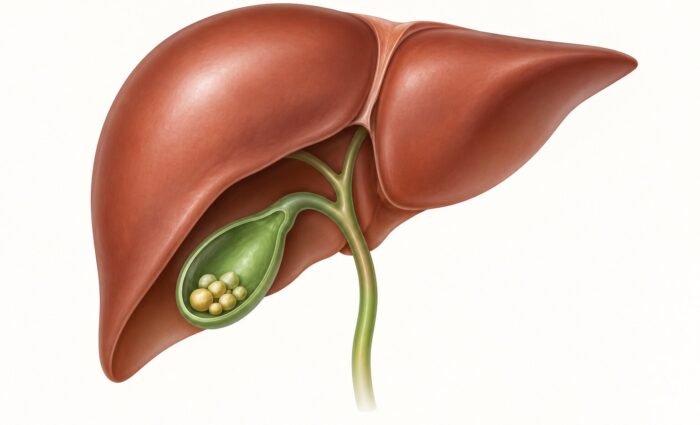
What is a laparoscopic cholecystectomy?
Laparoscopic cholecystectomy is a keyhole operation to remove the entire gallbladder through several small abdominal incisions under general anaesthesia. It is the best treatment when gallstones cause recurrent pain, inflammation or other complications, typically takes approximately 30 to 60 minutes, and is usually performed as day-case surgery.
Why is the whole gallbladder removed?
Gallstones usually form because of conditions within the gallbladder. Removing individual stones while leaving the gallbladder in place would allow further stones and symptoms to develop.
The gallbladder is therefore removed together with the stones. It is not an essential organ, and most people return to a normal diet and normal activities after recovery.
When is gallbladder removal recommended?
Surgery may be considered with:
- Recurrent biliary colic or gallstone pain that affects normal activities
- Cholecystitis (gallbladder inflammation)
- Gallstone pancreatitis
- Jaundice or bile-duct obstruction
- Cholangitis or bile-duct infection
- Selected gallbladder polyps
- Gallbladder dysfunction.
What happens before surgery?
Before proceeding, Mr Wood will review:
- Your symptoms and previous gallstone attacks
- Ultrasound, MRI, CT or other imaging
- Blood-test results
- Your medical history and any previous abdominal surgery
- The expected benefits, limitations and risks of treatment
You will also undergo hospital pre-assessment. This commonly includes routine blood tests, an ECG or other tests depending on your age and health.
You will be given instructions about fasting and which medicines should be continued, adjusted or temporarily stopped.
How should I prepare for surgery?
Before your operation, you may be advised to:
- Stop smoking
- Maintain regular gentle exercise
- Follow a healthy diet
- Improve the control of diabetes or other medical conditions
- Avoid shaving or waxing the abdominal area immediately before surgery
- Arrange for someone to take you home and remain with you initially after surgery
- Some overweight patients may be advised to follow a short liver-shrinkage diet before surgery.
What happens during the operation?
After the general anaesthetic has been administered:
- A small incision is usually made close to the umbilicus.
- Carbon dioxide gas is introduced to create space within the abdomen.
- A laparoscope / camera is inserted.
- Several additional small incisions are made for surgical instruments.
- The gallbladder, cystic duct and cystic artery are carefully identified.
- The cystic duct and artery are divided and secured.
- The gallbladder is separated from the liver and removed through one of the incisions.
- The operative area is checked before the instruments are removed and the incisions are closed.
What happens if the operation is complex?
Previous inflammation can cause the gallbladder to become contracted, thickened or densely scarred to surrounding structures.
Complexity may also be increased by:
- Previous acute or repeated cholecystitis
- Gallstone pancreatitis
- Bile-duct stones
- Previous abdominal surgery
- Unusual gallbladder or bile-duct anatomy
- Significant medical or anaesthetic considerations
If removing the entire gallbladder would be unsafe, a subtotal / partial cholecystectomy may be performed. This removes most of the gallbladder while leaving a small portion in place to reduce the risk of injury to the bile duct or nearby structures.
Occasionally, the operation must be converted to open surgery through a larger incision. This is done when necessary for safety rather than representing a surgical failure.
Mr Wood completes more than 99% of his gallbladder operations laparoscopically, although the result of an individual operation cannot be guaranteed.
What are the risks of laparoscopic gallbladder removal?
Laparoscopic cholecystectomy is a commonly performed operation, but all surgery carries risks.
General risks
These include:
- Bleeding
- Wound infection
- Chest infection
- Blood clots in the legs or lungs
- Allergic reactions
- Anaesthetic complications
- Hernia formation at an incision
- Injury to the bowel, liver, blood vessels or other internal structures
Risks specifically associated with gallbladder surgery
These include:
- Bile leaking from the gallbladder bed or cystic duct
- Stones remaining within the bile duct
- Stones or bile spilling into the abdomen
- Injury to the main bile duct
- Continued abdominal symptoms despite removal of the gallbladder
- Temporary or persistent changes in bowel habit
- The need for ERCP, drainage, further imaging or another procedure after surgery
- Subtotal cholecystectomy
- Conversion to open surgery
Bile-duct injury is uncommon but potentially serious. Published estimates vary between 1 in 500-700, but your individual risk depends partly on the degree of inflammation, scarring and anatomical complexity.
Will I go home on the day of surgery?
Most laparoscopic cholecystectomies are intended as day-case procedures and is actually the best way to achieve a rapid recovery.
You may need to remain overnight if:
- Surgery finishes later in the day
- You require additional pain relief or anti-sickness treatment
- You are not yet eating, drinking or mobilising adequately
- A drain has been inserted
- Your operation was more complex than expected
- There is another clinical or social reason for observation
You will only be discharged when the clinical team is satisfied that it is safe for you to go home.
What is recovery like after gallbladder removal?
Some abdominal discomfort is expected during the first few days. Shoulder-tip pain can also occur because of the gas used during laparoscopic surgery.
After surgery:
- Take the recommended pain relief
- Walk gently and regularly
- Keep the wounds clean and follow the dressing instructions
- Gradually increase your activities
- Avoid strenuous exercise and heavy lifting until comfortable
- Arrange transport / someone to drive you home
- Have a responsible adult remain with you initially
Mr Wood’s patients frequently report a rapid recovery with relatively little need for pain medication, although recovery varies and individual experiences cannot be guaranteed.
When can I drive?
Do not drive until:
- You are no longer affected by the anaesthetic or sedating pain medication
- You can sit comfortably and wear a seat belt
- You can safely control the vehicle and perform an emergency stop without pain or hesitation
You should also check any requirements imposed by your motor insurer.
When can I return to work?
Many patients with sedentary or light duties return to work within approximately one to two weeks.
You may require longer if:
- Your work involves heavy lifting or have a physically demanding occupation
- Your operation was complex or required open surgery
- Your recovery is slower than expected
Advice will be tailored to your occupation and progress.
What can I eat after gallbladder removal?
Most people can gradually return to a normal, healthy diet.
Smaller or lighter meals may be more comfortable during the first few days. Some people temporarily notice looser or more frequent bowel movements or sensitivity to certain foods.
A permanent low-fat diet is not routinely required. Persistent diarrhoea or digestive symptoms should be discussed with your clinician because treatment may be available.
When should I seek urgent medical advice after surgery?
Seek urgent medical advice if you develop:
- Severe or worsening abdominal pain
- Persistent vomiting
- Fever, shivering or feeling acutely unwell
- Increasing abdominal swelling
- Yellowing of the skin or eyes, dark urine or pale stools (jaundice)
- Redness, swelling, pus or increasing pain around a wound
- Difficulty breathing or chest pain
- Pain or swelling in one leg
- Faintness, confusion or marked weakness
Contact the hospital or your clinical team using the instructions provided at discharge. You can also contact NHS 111 or attend an emergency department. Call 999 in an emergency.
Why choose Mr Simon Wood?
Mr Simon Wood is a Consultant General and Upper Gastrointestinal Surgeon with particular expertise in gallstones and gallbladder disease.
He has:
- Performed more than 1,000 laparoscopic cholecystectomies
- Extensive experience treating straightforward and complex gallstone disease
- Experience managing gallbladder inflammation, pancreatitis and bile-duct stones
- Particular experience with symptomatic gallstones developing during or after GLP-1 weight-loss treatment
- Specialist training in General and Upper Gastrointestinal Surgery
- Completed a Senior Fellowship in Upper GI Surgery in Adelaide, Australia
- Gained a Master’s degree in Minimally Invasive Surgery
- Surgical leadership experience as National Clinical Lead for General Surgery in Wales and previously Clinical Director for General Surgery
- Taught laparoscopic surgical skills at the Royal College of Surgeons of England
Private gallbladder surgery costs
A private consultation with Mr Wood currently costs £185.
Planned day-case laparoscopic gallbladder surgery currently starts from approximately £6,935, excluding the initial consultation.
This is an indicative starting cost rather than a guaranteed fixed price. The eventual cost depends on hospital charges, investigations, admission arrangements and individual clinical requirements.
Frequently asked questions
How long does gallbladder removal take?
A straightforward laparoscopic cholecystectomy commonly takes approximately 30 to 60 minutes. Complex surgery may take longer.
How many incisions are used?
Most operations usually use 4 small abdominal incisions.
Are stitches removed afterwards?
The incisions are commonly closed using dissolvable stitches not requiring removal.
Is a drain routinely used?
No. A drain is not routinely required but may be inserted following a complex operation, bile-duct exploration or concern about bile or fluid leakage.
Can gallstones return after the gallbladder is removed?
Gallstones cannot reform within a gallbladder that has been removed. Stones can rarely remain or subsequently develop within the bile ducts.
Can I live normally without a gallbladder?
Yes. The gallbladder stores bile but is not essential. Most patients return to a normal diet and normal activities after recovery.
Will surgery cure all my abdominal symptoms?
Not necessarily. Surgery is most likely to help when the symptoms are typical of gallstone disease. Indigestion, bloating and non-specific abdominal discomfort can have other causes.
Is private medical insurance accepted?
Mr Wood is registered with the principal private medical insurers listed on this website. The usual CCSD procedure code for laparoscopic cholecystectomy is J1830. Your insurer must confirm cover, authorisation, excesses and any applicable fee limits.
Arrange a private gallbladder consultation
If you have symptomatic gallstones, recurrent gallbladder pain or have been advised to consider cholecystectomy, you can arrange a private consultation with Mr Simon Wood at St Joseph’s Hospital in Newport.
Your symptoms and investigations will be reviewed, and the expected operation, benefits, risks, recovery and costs will be discussed.