

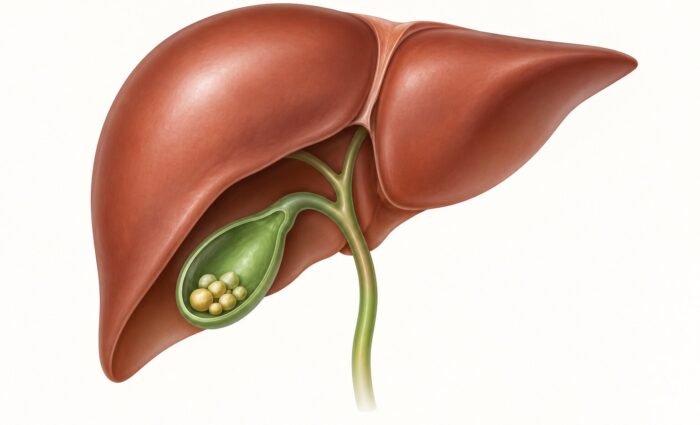
Gallstones are common and often cause no problems. If they obstruct the gallbladder or bile ducts, they can cause pain, inflammation, jaundice or pancreatitis.
Mr Simon Wood is a Consultant General and Upper Gastrointestinal Surgeon with extensive experience treating gallstone disease. Consultations are available at St Joseph’s Hospital, Newport for patients from across South Wales, Cardiff, Bristol and elsewhere in the UK.
What is the gallbladder?
The gallbladder is a small organ beneath the liver. It stores bile and releases it into the small bowel to help digest fats.
The gallbladder is not essential. After removal, bile passes directly from the liver into the bowel, and most people return to a normal diet.
What are gallstones?
Gallstones are solid deposits that form in the gallbladder. They may be made from cholesterol, bile pigments or a mixture of substances.
Many people have gallstones without symptoms, and they are often found incidentally during an ultrasound or other scan.
What causes gallstones?
Gallstones develop when the composition of bile changes or the gallbladder does not empty normally.
Factors associated with gallstones include:
- Increasing age
- Female sex
- Pregnancy
- A family history of gallstones
- Being overweight or living with obesity
- Rapid or substantial weight loss
- Previous weight-loss surgery
- Diabetes
- Crohn’s disease or other small-bowel conditions
- Certain blood disorders
- Some medicines
What symptoms do gallstones cause?
Gallstones can cause no symptoms but when they do, the most typical symptom is biliary colic.
This usually causes:
- Pain in the upper abdomen, beneath the right ribs, in the right flank, shoulder, chest or back
- An episode lasting from 30 minutes to several hours
- Nausea or vomiting
- Pain often triggered by eating, particularly a rich or fatty meal
Other symptoms including indigestion, bloating and general abdominal discomfort can be caused by gallstones but may have other causes. Finding gallstones on a scan does not necessarily mean they are responsible for every symptom, so careful assessment is important before surgery.
What complications can gallstones cause?
Gallstones can obstruct the gallbladder or bile ducts and cause complications.
Acute cholecystitis
Acute cholecystitis is inflammation of the gallbladder, usually caused by a stone becoming trapped at its outlet. It typically causes persistent pain beneath the right ribs, tenderness, fever and sometimes vomiting.
Jaundice and bile-duct stones
A stone can pass into and obstruct the common bile duct, causing:
- Yellowing of the skin or eyes
- Dark urine
- Pale stools
- Itching
- Abnormal liver blood tests
Bile-duct stones may require removal by ERCP or during surgery.
Cholangitis
Cholangitis is an infection in an obstructed bile duct. It can cause abdominal pain, fever, shivering and jaundice and requires urgent treatment.
Gallstone pancreatitis
A stone passing through the bile duct can trigger inflammation of the pancreas. This usually requires hospital admission.
Less common complications include gallbladder perforation, fistula formation and bowel obstruction caused by a gallstone.
When should I seek urgent medical help?
Seek urgent medical advice if you develop:
- Severe or persistent abdominal or back pain
- Repeated vomiting
- Fever, shivering or feeling acutely unwell
- Yellowing of the skin or eyes
- Dark urine or pale stools
- Confusion, faintness or marked weakness
These symptoms may indicate gallbladder inflammation, bile-duct obstruction, infection or pancreatitis.
If symptoms are severe or rapidly worsening, contact NHS 111 or attend an emergency department. Call 999 in an emergency.
Do gallstones always need treatment?
Gallstones found incidentally and causing no symptoms commonly require no treatment.
Treatment is more likely to be recommended for:
- Recurrent biliary colic
- Symptoms that significantly affect daily life
- Acute cholecystitis
- Gallstone pancreatitis
- Jaundice or bile-duct stones
- Cholangitis
The decision about surgery depends on your symptoms, scan findings, previous complications, general health and preferences.
How are gallstones investigated?
Assessment begins with a review of your symptoms and medical history.
Blood tests
Blood tests can identify inflammation, infection, liver disturbance, bile-duct obstruction or pancreatitis. Results may be normal between attacks.
Ultrasound
An abdominal ultrasound is usually the first scan. It can identify gallstones, gallbladder inflammation, enlarged bile ducts, polyps and some alternative causes of symptoms.
MRI or MRCP
MRCP provides detailed images of the bile ducts and may be recommended if blood tests or ultrasound suggest a bile-duct stone.
Other tests, such as CT, endoscopic ultrasound or gastroscopy, may be recommended when needed to investigate alternative diagnoses.
How are symptomatic gallstones treated?
The usual definitive treatment is laparoscopic cholecystectomy, which removes the entire gallbladder rather than just the stones.
Most planned operations are performed through several small incisions under general anaesthesia and are intended as day-case procedures.
Can gallstones be treated without surgery?
Not usually. Dietary changes and pain relief may help control symptoms while you await assessment, but they do not remove established gallstones.
You may be advised to:
- Avoid foods that trigger symptoms
- Reduce rich or fatty meals
- Eat smaller meals
- Use appropriate pain relief
- Seek medical advice if symptoms change or persist
Medicines that dissolve gallstones are suitable for relatively few patients, can take a long time to work and may be followed by recurrence. Techniques used to fragment kidney stones are not routinely used for gallstones.
What happens if there are stones in the bile duct?
Common bile-duct stones usually require treatment because they can cause obstruction, infection or pancreatitis.
Treatment may involve:
- ERCP before or after gallbladder surgery
- Removal during laparoscopic surgery
- Additional imaging to guide treatment
The gallbladder is often subsequently removed to reduce the risk of further stones passing into the bile duct.
What are gallbladder polyps?
Gallbladder polyps are growths from the inner lining of the gallbladder. Most small polyps are benign.
Management depends on the polyp’s size and appearance, whether it is growing, your age and risk factors, and whether you have symptoms or gallstones.
Larger or growing polyps may require gallbladder removal. Smaller polyps may be monitored with ultrasound. A specialist should interpret the findings in context.
What is gallbladder dysfunction?
Gallbladder dysfunction describes abnormal emptying of the gallbladder in someone with typical biliary symptoms but no visible gallstones.
Other causes of abdominal pain usually need to be excluded first. In selected cases, a functional scan may assess gallbladder emptying, although an abnormal result does not guarantee that surgery will resolve symptoms.
Gallstones and Mounjaro or other GLP-1 medicines
Rapid weight loss, including weight loss associated with GLP-1 medicines such as Mounjaro, may increase the risk of gallstones.
If you develop symptoms, seek medical advice. Treatment decisions, including whether to continue the medicine, should be discussed with the prescribing clinician.
What happens during a specialist consultation?
During your consultation, Mr Wood will:
- Review your symptoms and previous attacks
- Assess your blood tests and imaging
- Consider whether the gallstones explain your symptoms
- Check for complications and alternative causes
- Discuss whether surgery is appropriate
- Explain treatment options, risks and recovery
- Recommend any further investigations
A GP referral is helpful but is not always essential for a self-pay consultation. Please bring your previous clinic letters, blood results, ultrasound reports and other imaging.

Why choose Mr Simon Wood?
Mr Simon Wood is a Consultant General and Upper Gastrointestinal Surgeon with particular expertise in gallstones and gallbladder disease.
He has:
- Performed more than 1,000 laparoscopic cholecystectomies
- Extensive experience treating complex gallstone disease
- Experience managing gallbladder inflammation, pancreatitis and bile-duct stones
- Been highly rated by patients, who frequently comment on his clear explanations, reassuring manner and attentive care
- Specialist training in General and Upper Gastrointestinal Surgery
- Completed a Senior Fellowship in Upper GI Surgery in Adelaide, Australia
- Gained a Master’s degree in Minimally Invasive Surgery
- Served as National Clinical Lead for General Surgery in Wales
- Taught laparoscopic surgical skills at the Royal College of Surgeons of England
Frequently asked questions
Can gallstones disappear by themselves?
Gallstones usually remain in the gallbladder unless they pass into the bile duct or bowel. Passing stones can cause jaundice, infection or pancreatitis.
Can diet dissolve gallstones?
No diet reliably dissolves established gallstones. Avoiding trigger foods may reduce symptoms but does not remove the stones.
Can I live normally without a gallbladder?
Yes. Most people return to a normal diet and normal activities after recovery. Some experience temporary changes in bowel habit or sensitivity to certain foods.
Can gallstones return after gallbladder removal?
Stones cannot reform in a gallbladder that has been removed. Stones can rarely remain or form in the bile ducts.
Are gallstones dangerous?
Most gallstones do not cause serious problems. Symptomatic stones can occasionally cause inflammation, bile-duct obstruction, infection or pancreatitis.
Is surgery necessary after one attack?
Not always. The decision depends on your symptoms, scan findings, previous complications, general health and likelihood of further attacks.
Can gallstones cause back pain?
Yes. Gallstone pain can spread to the back or right shoulder. Back pain alone, however, has many possible causes.
How much does private gallbladder surgery cost?
A private consultation with Mr Wood currently costs £185. Planned day-case laparoscopic gallbladder surgery currently starts from approximately £6,935, excluding the initial consultation. Costs are indicative and depend on individual requirements and hospital charges.
Arrange a private gallbladder consultation
If you have symptomatic gallstones, recurrent upper abdominal pain, a gallbladder polyp or a previous gallstone complication, you can arrange a private consultation with Mr Simon Wood at St Joseph’s Hospital in Newport.
The consultation will review your investigations and symptoms and discuss the most appropriate next steps.
Initial consultation: £185
Comments (2)
Laparoscopic Gallbladder Removal | South Wales
September 9, 2026[…] Read about gallstones and gallbladder conditions […]
Gallstones and Mounjaro / GLP-1 Medicines - Simon Wood
September 10, 2026[…] Read more about gallstones and gallbladder conditions […]